Commercial Plywood serves very different markets, from cabinet workshops in Vietnam to concrete sites in Germany. Buyers rarely need the same panel twice. A low-cost interior board may fail quickly in humid storage. A dense birch panel may be excessive for temporary packaging. The right choice depends on use, moisture exposure, face quality, bonding performance, and verified supply.
The FAO Global Forest Products Facts and Figures 2023 reported global wood-based panel production at approximately 400 million cubic metres in 2022. This scale shows the sector’s importance, but it also reveals a problem: product names are not always consistent across exporting countries. Terms such as marine plywood, structural plywood, and commercial plywood can describe different specifications. Buyers should check core composition, veneer thickness, glue class, formaldehyde emissions, surface repairs, and tolerance data. Relevant references include EN 636, EN 314, ISO 1096, and applicable ASTM standards. Certification may matter too. FSC chain-of-custody documentation can support responsible sourcing, while laboratory reports can confirm performance.
This guide examines ten Commercial Plywood types commonly considered by global buyers. It compares hardwood, softwood, birch, film-faced, marine-grade, flexible, fire-retardant, and other application-focused panels. Not every category is equally standardized. That is worth remembering. A supplier’s attractive sample cannot replace batch inspection, moisture testing, and document review. The FAO data describes a broad market, not guaranteed product quality. Experienced importers still make mistakes when specifications remain vague. Clear purchase contracts, pre-shipment inspections, and traceable technical documents reduce that risk. The best panel is not always the strongest one. It is the panel that fits the application, budget, climate, and compliance requirements without hidden compromises.
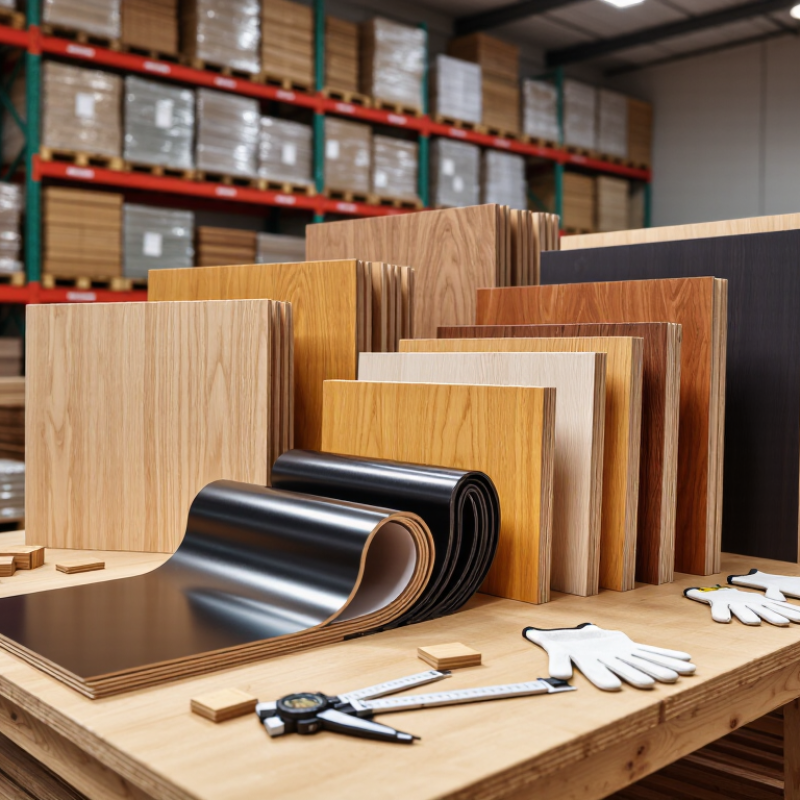
Commercial plywood is an engineered wood panel made from thin veneers bonded in layers. Each veneer is usually placed with its grain crossing the next layer. This cross-laminated structure improves stability and reduces splitting. Unlike decorative plywood, commercial plywood mainly serves practical construction, furniture, packaging, and interior applications.
Its performance depends on several details. Veneer thickness, wood species, adhesive quality, pressing temperature, and core arrangement all matter. A balanced panel can carry moderate loads while resisting warping during normal indoor use. Sanded faces provide a smoother surface for paint, laminate, or light finishing. Core gaps, overlaps, and uneven bonding can weaken screw holding and create visible defects.
Global buyers should check thickness tolerance, panel density, moisture content, emission class, and test documentation. Moisture-resistant grades may perform well in humid rooms, but they are not automatically suitable for constant outdoor exposure. That distinction is often overlooked. A panel can look flat at delivery and still move after installation if storage conditions are poor. Keep sheets level, dry, and raised from the floor. In practice, commercial plywood is reliable when its grade matches the environment, load, and finishing method. It is not flawless, and visual inspection should accompany every technical certificate.
Commercial plywood is not classified by appearance alone. Global buyers should check service conditions, bonding performance, structural strength, emissions, and surface quality. The FAO Forestry Production and Trade database shows the scale of this market, with global wood-based panel production exceeding 400 million cubic metres in recent reporting. That volume makes consistent standards essential.
Ten practical types appear frequently: interior plywood, exterior plywood, structural plywood, marine plywood, film-faced plywood, fire-retardant plywood, hardwood plywood, softwood plywood, flexible plywood, and overlaid plywood. However, these names do not carry identical meanings worldwide. EN 636 divides plywood into dry, humid, and exterior-use classes. EN 314-2 evaluates bonding through three bond classes. In North America, PS 1 and PS 2 focus on structural panel performance. JAS classifications support Japanese construction requirements, while AS/NZS 2269 covers structural plywood in Australia and New Zealand. ASTM D1037 provides widely used test methods, but it is not a complete product classification system.
Tips: Request the standard number, test report, thickness tolerance, formaldehyde result, and intended-use class. Do not accept “marine” as proof of permanent water resistance. The term is often used too loosely. A factory inspection I would trust includes random core checks, glue-line testing, and sheet measurements. Still, one inspection cannot represent every shipment. Buyers should compare batch records and independent laboratory results. Face veneer grade can hide weak inner plies, so edge inspection remains important.
Commercial Plywood Types and Their Distinctive Properties
Commercial plywood differs by core, adhesive, surface, and intended exposure. For global buyers, hardwood plywood offers dense faces, clean edges, and strong screw holding. Softwood plywood is lighter and often suits roofing, wall sheathing, and general construction. Tropical plywood uses dense regional species, but buyers should verify species, emissions, and grading documents. Interior plywood works in dry rooms, with a smooth surface for furniture and wall panels. Exterior plywood uses moisture-resistant adhesive for changing weather, not permanent immersion.
Marine plywood has carefully selected veneers and durable bonding, yet certification and thickness still matter. Structural plywood is graded for load-bearing use, with predictable strength and stiffness. Film-faced plywood has a resin-coated surface that releases concrete more easily and resists abrasion. Fire-retardant plywood can slow flame spread when tested and installed correctly. Flexible plywood bends around curves, although it usually needs a supporting frame and final finish.
In purchasing work, I compare core gaps, veneer repairs, moisture content, panel flatness, and test reports. A supplier’s label is only a starting point. I have seen attractive sheets warp after poor storage. That lesson remains useful. Buyers should confirm formaldehyde class, dimensions, tolerance, and destination-market requirements before shipment. Some specifications remain unclear. A small sample, checked after humidity exposure, can reveal weaknesses that photographs hide.
Top 10 Types of Commercial Plywood for Global Buyers?
Global buyers should match plywood types with site conditions, not catalogue labels. The FAO Forestry Production and Trade database recorded roughly 400 million cubic metres of wood-based panel production in 2022. That scale hides major performance differences. A dry interior partition may need sanded hardwood plywood. A humid kitchen requires moisture-resistant construction. Concrete formwork needs a smooth, durable film surface.
Project details guide the selection. For furniture, calibrated hardwood plywood supports clean edges and stable screw holding. For roofing, structural softwood plywood can reduce weight, but buyers should check bending strength and panel thickness. Marine-grade plywood suits repeated moisture exposure, yet “marine” does not mean unlimited immersion. High-density overlay panels work well for reusable forms, where release quality matters. Fire-retardant plywood may support public interiors, but certification must match the destination market.
Standards prevent costly assumptions. EN 636 classifies plywood for dry, humid, or exterior conditions, while EN 314 addresses bonding quality. North American projects often reference PS 1 or PS 2 performance requirements. The ITTO Biennial Review and Assessment of the World Timber Situation shows how tropical timber trade remains sensitive to legality checks and supply changes. Buyers should request test reports, formaldehyde data, core construction details, and batch samples. Measure twice.
The first specification is rarely perfect. A 12-millimetre panel may flex beside a 15-millimetre alternative, especially across longer spans. Freight humidity, edge sealing, and storage conditions also deserve attention. Suppliers sometimes describe these risks too simply. Practical trials remain necessary.
| Plywood Type | Typical Standard or Classification | Construction and Surface | Moisture and Performance | Common Thickness Range | Typical Applications | Best Buyer–Project Match |
|---|---|---|---|---|---|---|
| Interior MR Plywood | Interior-use plywood; often specified with urea-formaldehyde or equivalent interior bonding | Multiple wood-veneer layers with sanded faces; appearance grades vary by market | Dry conditions Not intended for prolonged dampness or exterior exposure |
3–25 mm | Indoor furniture, cabinets, partitions, wall lining, packaging and general joinery | Choose when the project is indoors, cost-sensitive and does not require water-resistant bonding |
| Exterior WBP Plywood | Exterior plywood; commonly associated with EN 314-2 Class 3 bonding or equivalent national requirements | Veneer layers bonded with weather-resistant adhesive; faces may be sanded or utility grade | Weather resistant Suitable for intermittent moisture; edges still require protection |
4–30 mm | Exterior cladding substrates, soffits, construction hoarding, outdoor joinery and transport packaging | Choose when panels may experience humidity or short-term wetting but are not permanently immersed |
| Marine Plywood | BS 1088 or comparable marine-plywood specification, subject to the buyer’s required certification | Durable veneers with controlled core gaps and weather-resistant bonding; usually sanded faces | High moisture resistance Designed for demanding wet environments; not automatically rot-proof |
4–25 mm | Boat interiors, decks, lockers, docks, outdoor structures and high-humidity fit-outs | Choose when low core-void risk, consistent bonding and high moisture exposure are critical |
| Structural Plywood | EN 636 structural classes, such as EN 636-1, EN 636-2 or EN 636-3; local structural standards may also apply | Engineered veneer lay-up intended to provide predictable strength and stiffness | Load-bearing Performance depends on the specified service environment and grade |
6–30 mm | Roof and wall sheathing, floor systems, diaphragms, formwork support and engineered timber construction | Choose by design loads, span, panel direction, moisture class and required structural certificates |
| Film-Faced Formwork Plywood | Construction formwork specification; requirements commonly include panel thickness, bonding, film weight and reuse expectations | Birch, hardwood or mixed hardwood core with resin-impregnated film on one or both faces | Water resistant surface Sealed edges and correct handling are essential for repeated reuse |
9–30 mm | Concrete wall, slab, column and foundation formwork | Choose according to concrete finish, panel size, number of reuses, loading and local formwork system |
| Overlaid Decorative Plywood | Decorative or industrial overlay specification; surface performance should be confirmed by test data | Base plywood covered with a resin-impregnated paper, wood veneer or other engineered overlay | Enhanced surface durability Resistance to abrasion, staining or chemicals depends on overlay type |
6–25 mm | Retail fixtures, vehicle interiors, furniture panels, wall panels and high-wear surfaces | Choose when appearance, cleanability or surface abrasion resistance is more important than low price |
| Fire-Retardant Plywood | Reaction-to-fire classification such as EN 13501-1; required class depends on the building application | Plywood treated or manufactured with a fire-retardant system; surface finish may be raw, painted or overlaid | Reduced flame spread Fire performance must be verified for the exact panel, thickness and installation |
6–25 mm | Public interiors, transport fit-outs, ceilings, wall systems and commercial partitions | Choose only after confirming the required fire class, smoke rating, treatment durability and documentation |
| Flexible Plywood | Flexible or bending plywood specification; performance is determined by bending radius and grain orientation | Thin veneers, often with a cross-grain structure designed to bend in one direction | Shape-forming Moisture resistance varies with adhesive and face material |
3–10 mm | Curved furniture, reception counters, exhibition displays, columns and interior architectural features | Choose according to minimum bend radius, bending direction, fixing method and final surface treatment |
| Film-Coated Vehicle and Trailer Plywood | Transport-flooring or vehicle-panel specification; slip resistance and load performance should be tested | Structural plywood with phenolic film; may include embossed or patterned anti-slip surface | Wear and moisture resistant Edges need sealing; surface pattern affects cleaning and traction |
9–30 mm | Truck floors, trailer decks, loading platforms, ramps and industrial walkways | Choose according to axle or wheel loads, slip requirement, abrasion level, panel span and service temperature |
| Birch-Faced Cabinet and Furniture Plywood | Appearance-grade plywood; face and back grades are commonly defined by regional grading systems | Fine-grained hardwood veneers with a smooth, uniform face suitable for machining and finishing | Stable and machinable Interior or exterior suitability depends on the adhesive and surface finish |
6–24 mm | Cabinet carcasses, drawers, furniture components, doors, shelving and premium interior joinery | Choose when clean edges, screw-holding, visual consistency and reliable machining are priorities |
Commercial plywood varies widely: structural softwood, hardwood, marine, film-faced, birch, poplar, eucalyptus, bamboo, fire-retardant, and flexible plywood serve different projects. The label alone proves little. FAO’s Forestry Production and Trade database reports global wood-based panel output above 400 million cubic metres in recent years. This scale makes supplier verification essential.
During factory audits, importers should inspect seven layers: veneer thickness, core gaps, glue spread, pressing temperature, sanding, edge sealing, and moisture content. A calibrated moisture meter should usually show 6–14%, depending on destination climate. Ask for recent test reports, not old samples. Check bending strength, bonding durability, screw holding, and surface defects against the agreed specification.
ISO 12465 supports plywood specification control, while EN 13986 may apply to panels used in European construction. Formaldehyde documentation should match the destination market, such as TSCA Title VI or equivalent limits. Mistakes happen when certificates describe a factory, but not the exact product.
Tips: Cut one sample panel during pre-shipment inspection. Count veneers, measure each face, and photograph the core. Confirm pallet weight and container loading records. Request chain-of-custody evidence for legal, responsible timber sourcing; FAO’s Global Forest Resources Assessment 2020 states that forests cover about 31% of global land area. A certificate is useful, but it is not a substitute for testing. Also, “marine grade” can be misunderstood; it usually refers to glue performance, not automatic waterproofing. Recheck this point.
Commercial plywood is made from layered wood veneers. Its core, adhesive, surface, and exposure rating affect performance.
Sanded hardwood plywood usually provides smooth faces and strong screw holding. It works well for cabinets, wall panels, and furniture.
Structural softwood plywood can reduce weight on roofs and walls. Check its thickness, bending strength, and span limits before installation.
Exterior plywood uses moisture-resistant adhesive for changing weather. It is not designed for permanent immersion.
No. Marine plywood has carefully selected veneers and durable bonding. Certification, thickness, edge sealing, and installation still matter.
Film-faced plywood has a resin-coated surface. It releases concrete more easily and resists repeated abrasion.
Choose it when tested flame-spread performance is required. The certification must match the destination market and installation method.
Request test reports, formaldehyde data, dimensions, tolerances, and core details. Inspect a small sample after humidity exposure.
Poor storage, freight humidity, and uneven support can distort panels. Keep sheets flat, dry, and raised from the floor.
No. A label is only a starting point. I may still miss hidden core gaps, repairs, or weak bonding without practical testing.
Commercial Plywood is an engineered wood panel made by bonding multiple layers of thin wood veneers with alternating grain directions, creating strength, stability, and consistent performance. This article explains how commercial plywood is classified through international standards related to grade, core construction, veneer quality, bonding performance, moisture resistance, and intended use. It introduces ten major types, highlighting their distinctive properties, such as smooth surfaces, lightweight structures, enhanced durability, improved dimensional stability, or suitability for interior and general construction applications.
For global buyers, selecting the right plywood type requires matching panel performance with project conditions, including load requirements, humidity, surface appearance, machining needs, and expected service life. The article also outlines essential purchasing checks, including thickness accuracy, core gaps, bonding quality, formaldehyde compliance, product documentation, and relevant certifications. By evaluating suppliers carefully and confirming technical specifications before shipment, importers can reduce quality risks, improve project reliability, and make more cost-effective purchasing decisions.

Quality